Whispers of Stone: Wandering Through Olympia’s Ancient Architecture
Have you ever walked through a place where time seems to pause, and every stone tells a story? Olympia, Greece, is exactly that—a living museum where ancient architecture breathes history. I wandered slowly through its sacred ruins, not chasing sights, but savoring moments. The Doric columns, weathered yet proud, stand as quiet testaments to a civilization that shaped Western thought. This isn’t just sightseeing—it’s soul-stirring. In a world that celebrates speed, Olympia invites us to step back, to walk softly through memory, and to listen. Here, the stones speak in low tones, not of conquest or chaos, but of order, beauty, and a deep reverence for the divine. To visit Olympia is not to check a box on a bucket list, but to enter into dialogue with the past.
The Spirit of Slow Travel in a Fast World
In an era defined by itineraries packed with highlights and destinations chosen for their Instagram appeal, the idea of moving slowly through a place can feel almost rebellious. Yet, more travelers—especially those seeking meaning beyond the surface—are embracing the philosophy of slow travel. This approach is not about how far you go, but how deeply you engage. It values presence over productivity, reflection over rushing. Olympia, nestled in the lush valley of the Alpheios River in the western Peloponnese, offers an ideal setting for this kind of journey. Unlike the bustling streets of Athens or the sun-drenched cliffs of Santorini, Olympia does not dazzle at first glance. Its power unfolds gradually, revealed in quiet corners and sunlit ruins.
Most tourists arrive by organized coach tours, often spending no more than two hours at the archaeological site before moving on. They follow a standard path, ticking off the Temple of Zeus, the stadium, and the altar of Hera before returning to their buses. But to experience Olympia fully is to resist this checklist mentality. It is to linger where the light falls just so on a fragment of marble, to sit on a stone bench once used by ancient priests, and to imagine the footsteps of athletes who once trained here. Slow travel allows space for such moments. It transforms a visit from a passive observation into an active communion with history.
What makes Olympia particularly suited to this reflective pace is its atmosphere. The site is surrounded by groves of olive and plane trees, their leaves rustling in the breeze like whispers from the past. Birdsong replaces the hum of traffic. The air carries the scent of earth and wild herbs—thyme, oregano, and sage—growing between the ruins. There are no souvenir stalls within the sanctuary grounds, no loudspeakers announcing guided tours. This absence of modern intrusion enhances the sense of timelessness. Visitors are not just seeing history; they are stepping into it. The practice of slow travel, therefore, is not merely a preference at Olympia—it feels like a necessity, a respectful response to the site’s sacred character.
Moreover, research in travel psychology suggests that mindful engagement with cultural sites leads to deeper emotional and cognitive benefits. When travelers slow down, they are more likely to retain information, form personal connections with the place, and report feelings of inspiration and peace. At Olympia, this translates into a richer understanding of ancient Greek values—harmony, balance, and the pursuit of excellence—not as abstract ideas, but as lived realities embedded in the landscape. The stones themselves become teachers, their silent forms instructing us in proportions that pleased the eye and spaces designed to elevate the spirit.
Olympia: More Than the Birthplace of the Games
For many, the name Olympia evokes one image: the Olympic Games. And rightly so—this was the birthplace of the ancient Olympics, a tradition that began in 776 BCE and continued for over a millennium. Every four years, athletes from across the Greek world gathered here to compete in honor of Zeus. Victors were crowned with olive wreaths and celebrated as heroes in their hometowns. Yet, to reduce Olympia to a sports venue is to miss its fuller significance. It was first and foremost a religious sanctuary, a place of pilgrimage and prayer, where athletic competition was one expression of a much broader spiritual and civic life.
The sanctuary of Olympia was dedicated to Zeus, king of the gods, and served as one of the most important Panhellenic centers in the ancient world. Alongside Delphi, Delos, and Isthmia, it hosted one of the four major sacred games. But unlike those sites, Olympia held a unique place in the Greek imagination. It was believed to be where Zeus himself had defeated his father, Cronus, in the Titanomachy—the great war of the gods. This mythic origin gave the site a divine aura, making it not just a location, but a symbol of cosmic order restored.
Today, the modern town of Olympia lies about a mile from the archaeological site. It is a modest settlement, with family-run hotels, quiet streets, and tavernas serving local specialties like grilled octopus, fava puree, and fresh figs. There is no nightlife or commercial hubbub. The rhythm of life here is gentle, shaped by the seasons and the flow of visitors. This tranquility mirrors the character of the ancient sanctuary, creating a continuity of atmosphere that enhances the visitor’s experience. Staying in the town allows travelers to wake early, arrive at the site before the tour groups, and enjoy the morning light filtering through the ancient columns—a privilege that aligns perfectly with the principles of slow, intentional travel.
The natural setting further deepens this sense of harmony. The Alpheios and Kladeos rivers frame the sanctuary, their waters glinting in the sun. In antiquity, these rivers were not only practical sources of water but also symbolic boundaries between the sacred and the profane. Pilgrims would cleanse themselves before entering the Altis, the sacred grove at the heart of the site. Even today, crossing the stone bridge over the Kladeos feels like a transition into another realm. The landscape has not changed dramatically in two thousand years, and walking through it connects the modern traveler to the same sensory experiences of ancient visitors—the cool shade of the trees, the sound of flowing water, the warmth of the sun on weathered stone.
First Steps: The Sanctuary of Zeus and the Sacred Altis
Entering the archaeological site of Olympia, one passes through the Propylon, a reconstructed gateway that once marked the formal entrance to the sanctuary. Immediately, the pace of the world outside fades. Ahead lies the Altis, a sacred grove enclosed by a low stone wall, its name derived from the Greek word for “grove” or “clearing.” This was the spiritual heart of Olympia, a space set apart for the gods. Unlike modern religious sites built for congregational worship, the Altis was not a place for large gatherings. It was a precinct for rituals, sacrifices, and divine presence—where mortals approached the divine with reverence and restraint.
The Altis covers about twenty hectares and contains the most significant religious structures of the sanctuary. As you step into it, the first thing you notice is the contrast between openness and enclosure. The space is dotted with ruins, trees, and patches of wildflowers, yet it feels ordered, almost choreographed. The alignment of temples, altars, and treasuries follows a deliberate geometry, reflecting the Greek belief in cosmic harmony. Sunlight plays across the marble, illuminating fragments of column drums and the faint carvings on stone blocks. The scent of wild thyme rises from the earth, mingling with the dry warmth of sun-baked stone. There is a stillness here that is not empty, but full—of memory, of meaning, of quiet presence.
At the center of the Altis stands the Great Altar of Zeus, a massive circular structure made of packed ash and remains of ancient sacrifices. Unlike the temples around it, the altar was not built of stone but formed over centuries by the accumulation of ashes from countless burnt offerings. Every four years, during the Olympic Games, a hundred oxen were sacrificed here in Zeus’s honor—a ritual known as the hecatomb. Today, the altar is a simple mound, unadorned and humble in appearance, yet profoundly evocative. To stand beside it is to feel the weight of collective devotion, the shared faith of a civilization that sought favor from the heavens through fire and flame.
Surrounding the altar are the foundations of temples, treasuries, and smaller shrines, each telling a fragment of Olympia’s long history. The arrangement of these structures follows a sacred logic—temples oriented east to west, so that the rising sun would illuminate the cult statue within. This alignment was not merely architectural; it was theological. Light was a symbol of divine presence, and the Greeks designed their sacred spaces to invite it in. Walking through the Altis, one begins to see how architecture, religion, and nature were not separate domains in antiquity, but interwoven threads in a single tapestry of meaning.
Doric Mastery: The Temple of Hera and Its Silent Columns
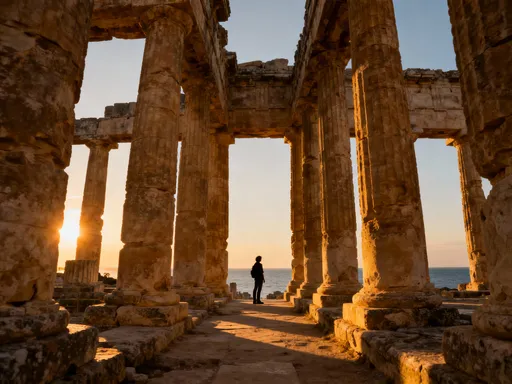
Among the earliest and best-preserved structures in the Altis is the Temple of Hera, often referred to as the Heraion. Built around 590 BCE, it is one of the oldest stone temples in Greece and a prime example of early Doric architecture. Originally constructed with wooden columns, it was later rebuilt in stone, though some of the original wooden elements were preserved, a rare survival from the Archaic period. Today, fifteen of its columns still stand, their fluted shafts rising toward the sky in weathered dignity. They do not gleam white like modern reconstructions might suggest; instead, they bear the golden patina of age, streaked with lichen and softened by time.
The temple was dedicated to Hera, queen of the gods and goddess of marriage and fertility, though over time it came to house the cult of Zeus as well. Within its cella once stood the famous chryselephantine (ivory and gold) statues of Zeus and Hera, though these have not survived. More significantly, the temple played a central role in the modern Olympic tradition: it is here, under the ancient columns, that the Olympic flame is lit using a parabolic mirror to capture the sun’s rays. This ceremony, held months before each Olympic Games, connects the modern event to its ancient roots in a powerful, symbolic way. The flame, kindled in silence and reverence, becomes a bridge across millennia.
Architecturally, the Temple of Hera exemplifies the evolution of the Doric order. Its columns are sturdy, with pronounced entasis (a slight bulge in the shaft) that gives them a sense of strength and vitality. The capitals are simple—rounded echinus and square abacus—without the ornate flourishes of later styles. The temple’s proportions reflect the early Greek pursuit of balance and clarity. It is not grand in scale—only six columns across the front, fourteen along the sides—but it is harmonious, its form dictated by mathematical precision and aesthetic restraint. This was architecture as philosophy, where beauty emerged from order, and order reflected the structure of the cosmos.
What makes the Heraion especially moving is its longevity. For over 2,600 years, it has stood through earthquakes, invasions, and the slow erosion of time. It has witnessed the rise and fall of empires, the spread of new religions, and the rediscovery of its own significance in the modern era. Yet it remains, not as a ruin in the sense of collapse, but as a presence. Its columns, though cracked and leaning slightly, continue to define the skyline of the Altis. To walk among them is to feel the persistence of human aspiration—the desire to build something that lasts, to honor the divine, and to leave a mark that time cannot fully erase.
Grandeur in Ruin: The Temple of Zeus and Architectural Ambition
If the Temple of Hera represents the dawn of classical architecture, the Temple of Zeus embodies its full flowering. Completed around 456 BCE, it was one of the largest temples in the ancient Greek world and ranked among the Seven Wonders of the Ancient World. Designed by the architect Libon of Elis, it was a statement of civic pride and religious devotion. Though now in ruins, its remaining columns—some re-erected in the 19th century—still convey a sense of awe. Standing beside them, one can imagine the original structure: 64 feet high, with 13 columns along the long sides and 6 at each end, enclosing a massive cella that housed one of the most celebrated statues of antiquity.
That statue, created by the sculptor Phidias around 430 BCE, was a chryselephantine masterpiece over 40 feet tall. Seated on a cedarwood throne inlaid with ivory and gold, Zeus held a figure of Nike, the goddess of victory, in his right hand and a scepter topped with an eagle in his left. Ancient sources describe it as so lifelike that visitors felt the god might speak. Though the statue was later moved to Constantinople and destroyed in a fire, its fame endured, inspiring countless depictions in art and literature. The temple itself was designed to showcase this wonder, with its high ceiling and strategic lighting allowing sunlight to illuminate the statue’s face at certain times of day.
The temple’s exterior was equally impressive. Its metopes—rectangular panels above the columns—were carved in high relief, depicting the Twelve Labors of Heracles. These scenes were not merely decorative; they conveyed moral and religious messages about perseverance, divine favor, and the triumph of order over chaos. The east pediment showed the chariot race between Pelops and Oenomaus, a mythic event said to have taken place at Olympia, while the west pediment depicted the battle between the Lapiths and Centaurs, symbolizing the struggle between civilization and barbarism. These sculptures, now housed in the on-site museum, are masterpieces of classical art, their figures full of movement and expression.
What strikes the modern visitor is not just the scale of the temple, but the ambition behind it. To build such a structure in the 5th century BCE required immense resources, skilled labor, and a shared vision. It was funded by the city-states of the Peloponnese as an offering to Zeus, a collective act of piety and unity. The temple was not just a religious building; it was a declaration of identity. Its ruins today, scattered with column drums and fragments of entablature, still speak of that ambition. They remind us that great architecture is born not from vanity, but from a desire to honor what is greater than oneself.
Beyond Temples: Stadium, Palaestra, and Civic Life in Stone
While the temples of Zeus and Hera capture much of the attention, Olympia was not solely a religious site—it was also a center of athletic and civic life. The ancient Games were only one part of a larger culture of physical training, competition, and communal gathering. The architectural remains of the stadium, palaestra, and gymnasium offer insight into how the Greeks integrated body, mind, and society. These were not merely functional spaces; they were designed with the same attention to proportion and harmony as the temples, reflecting the Greek ideal of kalokagathia—beauty and goodness united in the well-rounded individual.
The stadium, located just outside the Altis, could hold up to 45,000 spectators. Unlike modern stadiums with concrete stands, it consisted of earthen embankments covered with grass, where spectators sat or stood to watch the events. The track was 192 meters long—the length of a stade, from which the word “stadium” derives. Athletes competed in the nude, a practice that emphasized equality and the celebration of the human form. Today, visitors are allowed to walk the track, a rare privilege at an ancient site. As you step onto the packed earth, it is easy to imagine the roar of the crowd, the dust rising with each footfall, the tension before the starting signal. The experience is visceral, connecting the body to history in a way that no museum display can match.
Adjacent to the stadium is the palaestra, a square courtyard surrounded by colonnades where athletes trained in wrestling, boxing, and the pankration—a brutal combination of the two. The building included rooms for bathing, oiling, and socializing, reflecting the holistic nature of Greek athletics. Training was not just about strength or speed; it was part of education and character formation. Young men learned discipline, endurance, and respect for their opponents. The palaestra’s design facilitated this—open to the sky, bathed in light, with spaces for both physical exertion and philosophical conversation. Nearby, the gymnasium, a long covered running track, provided additional training space and shelter from the sun.
These structures illustrate a key principle of Greek urban planning: architecture served human purpose. Unlike monumental buildings meant only for display, the athletic facilities were designed for use, for interaction, for life. Even today, their layout encourages movement and engagement. Families walk through the colonnades, children run across the palaestra’s floor, and visitors pause to read the inscriptions on ancient victory lists. The stones, though silent, still support community. In a world where public spaces are often designed for efficiency rather than meaning, Olympia offers a reminder of how architecture can nurture both body and soul.
Preservation and Perception: Seeing Olympia with Fresh Eyes
The Olympia we see today is the result of centuries of change—destruction, neglect, rediscovery, and restoration. Earthquakes in the 4th and 6th centuries CE damaged much of the site, and floods from the Alpheios River buried it under layers of silt. For over a thousand years, it lay hidden, known only through ancient texts. It was not until the 18th century that scholars began to locate the site, and excavations by the German Archaeological Institute began in 1875. Since then, careful work has uncovered the foundations, restored key columns, and protected fragile artifacts. Yet, preservation is not just about physical repair; it is also about how we perceive and engage with the past.
One of the challenges at Olympia is balancing authenticity with accessibility. Some columns have been re-erected using anastylosis—a method that reassembles original pieces with minimal new material. This allows visitors to grasp the original scale and form of the buildings without creating false impressions. However, not everything has been restored. Many ruins remain as they were found—scattered stones, broken capitals, and faint outlines in the earth. This approach respects the passage of time rather than trying to erase it. It invites visitors to use their imagination, to see not just what is there, but what once was.
For the mindful traveler, this is an opportunity. Instead of seeking perfect reconstructions, one can learn to read the site like a text—looking at textures, alignments, and shadows. A single column drum can tell a story of craftsmanship. The orientation of a temple reveals its connection to the sun and stars. The wear on a stone step speaks of countless footsteps over centuries. Educational signage, available in multiple languages, provides context without overwhelming. Audio guides and museum exhibits deepen understanding, but the most powerful lessons come from quiet observation.
To engage with Olympia fully, one need not be a scholar. Simple practices can transform the experience: sitting quietly for ten minutes, sketching a column, walking barefoot on the stadium track, or journaling impressions. These acts slow perception, allowing the mind to absorb what the eyes see. They align with the growing movement toward contemplative tourism—a way of traveling that values inner change as much as outer discovery. In such moments, the boundary between past and present softens, and the stones truly begin to speak.
Closing Reflection: Why Stone Still Speaks
Olympia endures not because it is perfectly preserved, but because it is profoundly human. Its stones are not cold relics; they are vessels of memory, shaped by hands that believed in beauty, order, and the sacred. To walk through its ruins is to participate in a conversation that began over two and a half millennia ago—one about excellence, balance, and our place in the cosmos. In a world that often feels fragmented and fast, Olympia offers a different rhythm: one of stillness, depth, and connection.
The architecture of Olympia teaches us that greatness does not require opulence. It emerges from proportion, purpose, and reverence. The temples were not built to impress, but to honor. The stadium was not constructed for spectacle, but for the cultivation of virtue. Every stone was placed with intention, every column raised as an offering. This is the lesson that transcends time: that the spaces we create reflect the values we hold.
For the traveler seeking more than a photograph or a checklist, Olympia is a pilgrimage. It asks not for speed, but for silence. Not for consumption, but for contemplation. It invites us to slow down, to listen, and to remember that we are part of a long story—one written in stone, whispered by the wind, and waiting to be heard. So the next time you plan a journey, consider not the busiest city or the most famous landmark, but the quiet places where history breathes. Because sometimes, the loudest truths are spoken in the softest voices.